
Walk into any WPC manufacturing facility and the density spec is one of the first things mentioned. It is printed on the product label, quoted in the technical datasheet, and discussed in every procurement conversation. But what does density actually mean for the material that ends up on a wall, a door, or a piece of furniture?
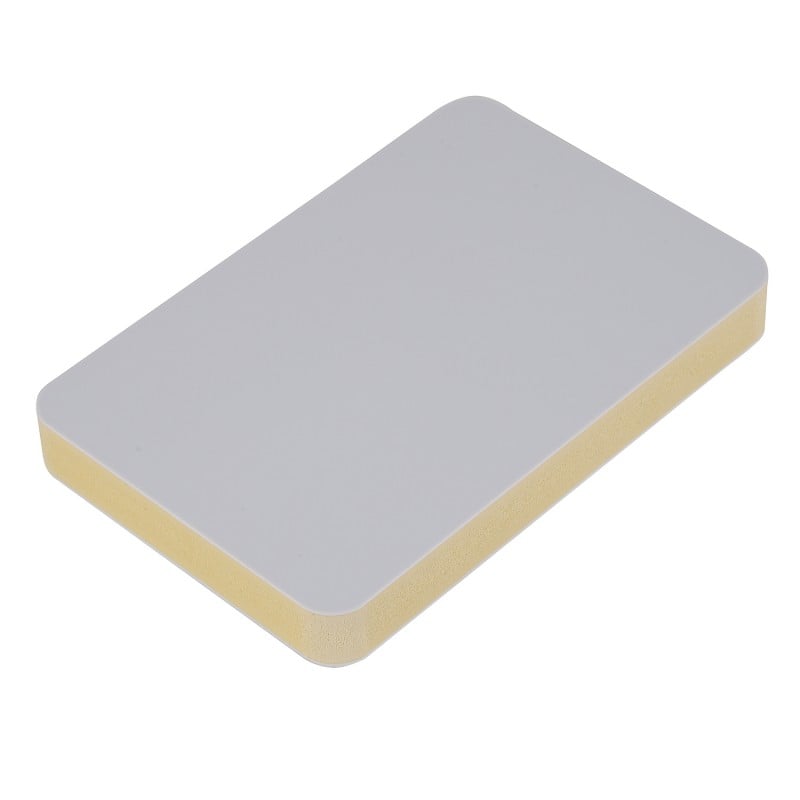
Density in WPC sheets typically ranges from 0.35 to 0.90 g/cm³. The difference between the low end and the high end is not just a number. It represents a fundamental trade-off between weight, strength, machinability, and cost. High-density sheets behave like engineered wood products. Low-density sheets handle more like rigid foam boards. Each has its place, and the choice between them affects everything from screw retention to shipping costs.
Mechanical strength in WPC materials is not a single value. It breaks down into several distinct properties. Flexural strength measures how much bending force a sheet can withstand before breaking. Flexural modulus indicates stiffness—how much the sheet deflects under load. Tensile strength covers pulling forces. Screw-holding strength determines how well fasteners stay put.
Density influences all of these properties, but not equally. Flexural strength and modulus show the strongest correlation with density. Higher density almost always means higher bending strength and greater stiffness. Tensile strength follows a similar pattern, though the relationship is less linear. Screw-holding strength depends heavily on density because the material surrounding the fastener needs enough solid structure to resist pull-out forces.
| Property | Low-Density WPC (0.35–0.50 g/cm³) | High-Density WPC (0.65–0.80 g/cm³) |
|---|---|---|
| Flexural strength | 12–18 MPa | 20–25 MPa |
| Flexural modulus | 650–750 MPa | 800–900 MPa |
| Screw holding | Moderate | Excellent |
| Impact resistance | Lower | Higher |
| Machinability | Easy, clean cuts | Requires sharper tools |
The data shows that high-density sheets deliver approximately 40 to 60% higher flexural strength than low-density sheets in the same thickness. That is a meaningful difference for any load-bearing application.
Higher density means more material per cubic meter. A sheet at 0.80 g/cm³ weighs more than twice as much as a sheet at 0.35 g/cm³ for the same dimensions. That weight difference has real consequences.
Shipping costs scale with weight for container shipments. A 40-foot container of high-density sheets hits the weight limit sooner than a container of low-density sheets. For a given container size, the high-density shipment carries fewer sheets. The per-sheet freight cost goes up accordingly.
Handling and installation also feel the weight difference. A high-density 18mm sheet weighs roughly 40% more than a low-density sheet of the same thickness. Installers working overhead or on tall walls notice the difference immediately. Fatigue sets in faster. The installation crew may need additional manpower or mechanical lifting aids.
The cost equation is not simply "high density equals better." The weight penalty is real, and it affects the total cost of ownership in ways that go beyond the material price.
Low-density WPC sheets, typically in the 0.35 to 0.50 g/cm³ range, excel in applications where weight is the primary constraint. Wall cladding, decorative panels, exhibition displays, and lightweight partitions all benefit from the reduced weight. The material is easier to cut, route, and install. Tooling lasts longer because the lower density creates less wear on cutting edges.
Medium-density sheets from 0.50 to 0.65 g/cm³ occupy the largest market share. They offer the best balance of strength and weight for furniture panels, door cores, and interior fit-out. This density range handles screw retention well enough for most applications while keeping weight manageable for shipping and installation.
High-density sheets above 0.65 g/cm³ move into structural territory. Work surfaces, load-bearing panels, industrial workbenches, and marine applications demand the higher strength that only dense material provides. The improved screw-holding strength means fasteners stay secure under vibration and cyclic loading. The higher impact resistance protects against accidental damage in high-traffic areas.
A furniture manufacturer producing office desktops switched from medium-density to high-density WPC sheets after a series of warranty claims related to screw pull-out. The desktops supported heavy monitor arms clamped to the edges. Over time, the clamping force and monitor weight caused screws to loosen and in some cases pull completely out of the material.
The switch to high-density sheets at 0.75 g/cm³ solved the problem. The screw-holding strength improved enough that the monitor arms stayed secure through the full warranty period. The added material cost was approximately 18% higher per sheet, but the warranty claim rate dropped from 7% to less than 1% in the first year after the change.
The same manufacturer tested low-density sheets for a different product line—lightweight display stands that needed to be portable and easy to assemble. The low-density material at 0.40 g/cm³ worked perfectly. The stands weighed significantly less than the medium-density version, reducing shipping costs by roughly 20% per unit. The lower density also made the stands easier for retail staff to move and reconfigure.
The lesson from that facility was clear. There is no single "best" density. The right density depends entirely on the application requirements and the trade-offs that matter most for that specific use case.
ASTM D7031 provides the standard guide for evaluating mechanical and physical properties of WPC products. The guide covers test methods for flexural strength, modulus of elasticity, tensile properties, and other key performance indicators. These standardized tests allow direct comparison between materials of different densities.
ASTM D7032 addresses performance ratings for deck boards and guardrail systems, specifically testing temperature and moisture effects, UV resistance, and freeze-thaw performance. The standard recognizes that density affects how WPC materials respond to environmental stressors. Higher density materials generally show better resistance to moisture absorption and freeze-thaw cycling.
ISO 178 provides the standard test method for flexural properties of plastics, including WPC materials. The test measures both flexural strength and flexural modulus under controlled conditions. Manufacturers use ISO 178 data to compare their products against industry benchmarks and to verify that production lots meet specification.
The standards exist because density alone does not tell the whole story. Two sheets with the same density can have different mechanical properties depending on the formulation, processing conditions, and filler content. The standardized tests provide the objective data needed to make informed decisions.
Higher density is not always better. The added weight increases shipping costs, complicates handling, and may require stronger support structures. For applications where the material is not subjected to significant loads, the extra density is wasted cost and weight.
Low-density sheets have their own limitations. Screw retention is a real concern for any application with fasteners. The material can compress under point loads, leaving indentations. Edges are more vulnerable to damage during transport and installation. The lower impact resistance means the sheets may not hold up in high-traffic areas.
The honest assessment is that density selection requires a careful analysis of the actual service conditions. Over-specifying density wastes money. Under-specifying density risks premature failure. The right choice sits somewhere in the middle, informed by the application requirements and the logistics constraints.
Oufei produces WPC sheets across the full density spectrum with consistent mechanical properties verified through ASTM and ISO test methods. The production lines maintain tight control over density and thickness, ensuring that every shipment meets the specified performance grade.
Copyright © 2026 by Hangzhou Oufei New Material Co.,Ltd. — Privacy Policy
 EN
EN

 Hot News
 ONLINE