
PVC lamination film thickness ranges from a wafer-thin twenty microns for lightweight decorative wraps to over two hundred microns for heavy-duty industrial skins. Choosing the right gauge is not simply a matter of picking a number off a chart. The substrate underneath dictates how the film behaves during application, how it wears over time, and whether it hides or magnifies surface defects. A film that performs flawlessly on a dense, flat MDF panel can look rippled and cheap when the same thickness is applied to a textured particleboard core.
The decision splits into three competing priorities: conformability, durability, and cost. Thinner films conform better to curves and surface irregularities but offer less scratch and impact resistance. Thicker films protect the substrate more aggressively but require higher lamination temperatures and longer dwell times, and they can bridge over fine textures instead of sinking into them, which creates a plastic-wrapped look that undermines the intended aesthetic. Knowing where the balance tips for each substrate keeps a project within budget while avoiding warranty claims.
Different substrates absorb heat, reflect surface texture, and move dimensionally in unique ways. The table below summarizes recommended film thickness ranges for five substrate types commonly encountered in furniture and interior panel production.
| Substrate | Recommended Film Thickness (microns) | Key Reason | Risk of Using Wrong Gauge |
|---|---|---|---|
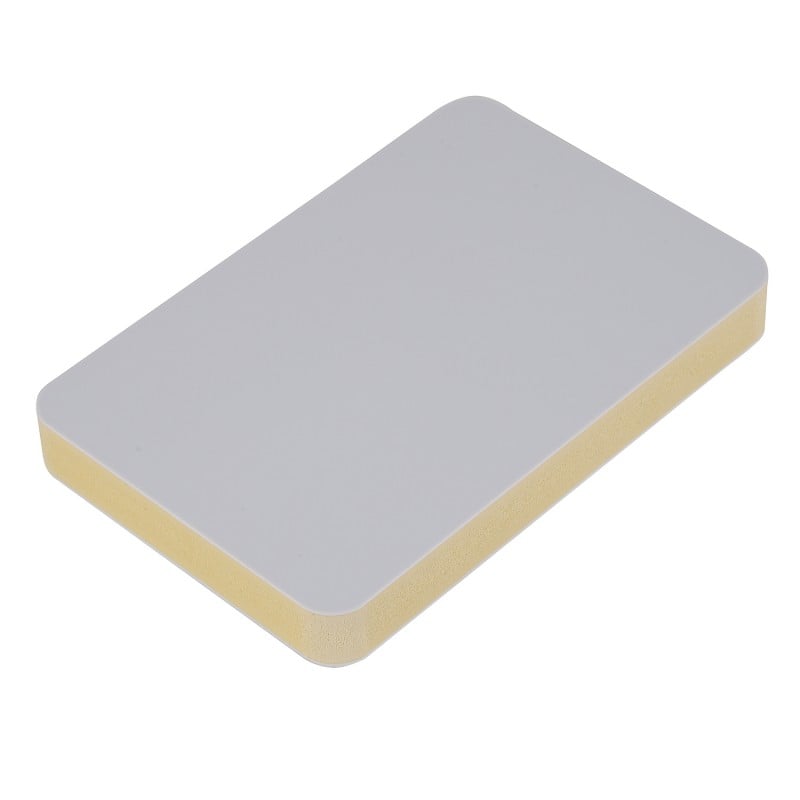
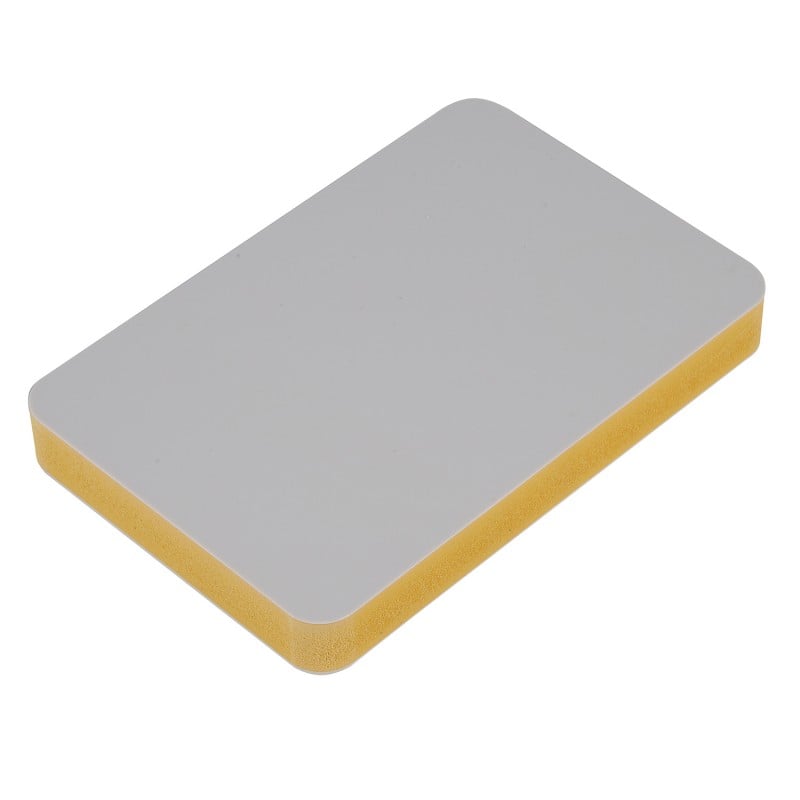
| PVC foam board | 80–150 | Smooth surface, chemical compatibility | Thin film shows roller marks; thick film adds unnecessary cost |
| MDF (medium-density fiberboard) | 120–180 | Fine, uniform surface, high heat absorption | Under 100 microns telegraphs fiber swell; over 200 microns prone to edge peel |
| Particleboard | 150–250 | Coarse texture needs coverage | Thin film reveals chip outline; thick film stiffens and resists wrap |
| Plywood (hardwood face) | 100–150 | Stable, but grain telegraphs | Thick film hides grain but may delaminate under moisture cycling |
| Gypsum board / drywall | 60–100 | Light duty, large flat areas | Thick film adds weight and cost with little benefit |
These ranges are starting points. A high-end particleboard with a fine surface sanding and a priming coat can accept a thinner film than a budget-grade board with coarse chips near the face. The substrate’s surface condition matters just as much as its material category.
A film that is thinner than the depth of the surface texture on the substrate will simply follow the contours, replicating every bump and depression. That can be desirable when the goal is a natural wood-grain feel on a textured embossed MDF panel. It becomes a problem when a smooth, glossy, piano-black finish is specified over a particleboard core that has subtle chip telegraphing. In that scenario, a film under one hundred twenty microns acts like shrink wrap, faithfully transmitting the irregular surface underneath. Stepping up to one hundred eighty or two hundred microns provides enough bulk to level out those micro-contours, producing a truly flat reflective surface.
Substrate flatness tolerance also interacts with film gauge. A large-format PVC foam panel that deviates by one millimeter per meter in flatness can still look acceptable with a one-hundred-micron matte film because the low gloss scatters light. The same panel covered with a sixty-micron high-gloss film will highlight every wave as a distorted reflection. Understanding this optical interaction prevents expensive mis-specifications on architectural wall panels where lighting conditions are beyond the installer's control.
Thicker films generally survive more abrasion cycles before the substrate becomes visible. Standard test methods like the Taber abrasion test (ASTM D4060) or the Erichsen scratch test quantify this. A ninety-micron PVC film might show visible wear after one hundred Taber cycles with a CS-10 wheel under a five-hundred-gram load. A one-hundred-fifty-micron version of the same formulation can push past two hundred cycles before failure. For horizontal surfaces like desk tops and shelving, that difference justifies the extra material cost. For vertical surfaces like wall panels and door skins that see only occasional contact, the thinner film delivers adequate durability at a better price point.
The substrate also influences perceived durability. A soft substrate like low-density PVC foam deforms under impact. Even a thick lamination film cannot prevent a dent if the core underneath compresses. In those cases, increasing film thickness alone solves the wrong problem. The smarter approach is to combine a moderately thick film with a substrate upgrade, such as a higher-density board or a reinforced skin layer, to create a system that resists both surface abrasion and impact deformation.
A contract furniture manufacturer producing flat-pack office desks had been using a one-hundred-sixty-micron PVC film on sixteen-millimeter MDF tops. The product sold well, but the manufacturer noticed a pattern in returns: edge lifting after twelve to eighteen months, especially on desks shipped to humid regions. The assumption was that the adhesive was failing, but pull-off tests showed the bond was intact. The real culprit was film stiffness. The one-hundred-sixty-micron film, chosen for its scratch resistance, carried enough internal stress from the lamination process that it pulled at the edges over time as the MDF expanded and contracted with seasonal humidity changes.
The manufacturer switched to a one-hundred-twenty-micron film with a lightly textured matte finish. The thinner gauge reduced the built-in lamination stress enough to eliminate the edge lifting problem. Scratch resistance dropped slightly on paper, but actual customer complaints about surface wear did not rise, because the matte texture hid minor scuffs better than the previous glossy finish. The material cost per square meter also dropped by roughly fifteen percent. This case underlines a point that gets overlooked in material selection: the best thickness is the one that balances mechanical stress, aesthetics, and durability for the specific substrate and use environment, not the thickest film the budget allows.
A lamination film's thickness must be uniform across the roll. A deviation of five microns across a twelve-hundred-millimeter-wide web creates uneven heat absorption during lamination, which leads to gloss variation, adhesive activation problems, and localized weak bonding. Film produced in a dedicated PVC film workshop, using fresh raw material rather than recycled content with unpredictable rheology, delivers the gauge consistency that high-speed lamination lines depend on. OFWPC, operating its own film extrusion alongside board production, controls thickness tolerance at the source. When a furniture factory runs two thousand panels per shift, the difference between a film with plus or minus three-micron tolerance and one with plus or minus ten-micron tolerance is the difference between a predictable output and a shift spent chasing defects.
Copyright © 2026 by Hangzhou Oufei New Material Co.,Ltd. — Privacy Policy
 EN
EN

 Hot News
 ONLINE