
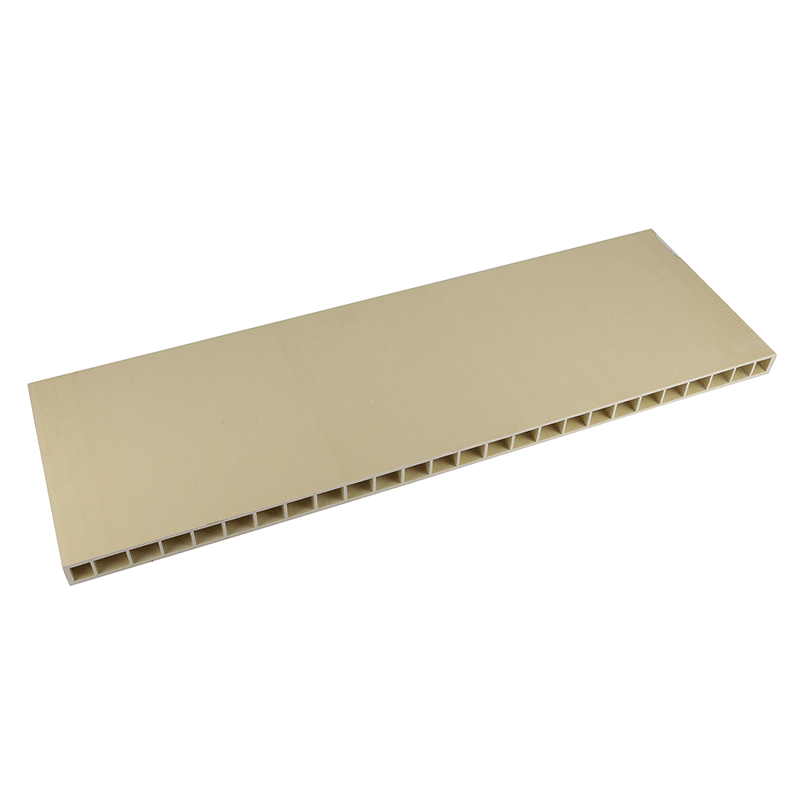
A co-extrusion sheet is built as a stack, and each layer has a different job. The core carries the load and holds the profile, usually a blend of wood flour and recycled PE or PVC. A tie layer, often a compatibilizer-rich compound, sits between core and cap to keep the two polymers talking to each other. The outer cap, typically ASA or modified PE, faces the weather. Durability in a multi-layer co-extrusion sheet comes from splitting the work: the core handles structure, the cap handles exposure, and the tie layer keeps the team from separating under heat and moisture cycling. A single-layer board asks one material to do all three jobs at once, and that is where the compromises start.
Wood flour is hydrophilic. That is not a flaw in the formulation, it is the nature of the fiber. In an uncapped sheet, those fibers sit at the surface and act like wicks. Water enters through cut ends, screw holes, and surface pores, then swells the fiber and opens microcracks. A co-extruded cap changes the surface energy of the board. The cap is polymer-rich and continuous, so water beads on it instead of soaking in. The core is still moisture-sensitive, but it is no longer the first line of defense. Under ASTM D570 immersion testing, a capped sheet typically holds water uptake under 1 percent, while an uncapped board of similar core formulation can drift into the 1.5 to 3 percent range. That gap looks small on paper. At a cut end in a rainy climate, it is the difference between a tight edge and a swollen one.
Ultraviolet light attacks polymer chains and lignin in the wood flour at the same time. The cap layer is formulated to take that hit. ASA is the common choice for exterior grade because its acrylic rubber phase resists embrittlement under UV and condensation cycling. PE caps cost less and perform well in milder exposures, but they are not interchangeable with ASA in high-sun, high-humidity service. Accelerated weathering under ASTM G154 with UVA-340 lamps shows the split clearly. An ASA-capped multi-layer sheet can hold color change within a Delta E of 3 after 2,000 hours, while an uncapped WPC board often moves into the 6 to 9 range, which is visible fade from across a deck. The cap is not just pigment. It is a sacrificial surface that keeps the core from becoming the UV target.
| Durability marker | Single-layer WPC sheet | Multi-layer co-extrusion sheet with PE cap | Multi-layer co-extrusion sheet with ASA cap |
|---|---|---|---|
| 24-hour water absorption, ASTM D570 | 1.5–3% | ≤1% | ≤0.5% |
| Color change after 2,000 h QUV, ASTM G154 | Delta E 6–9 | Delta E 4–5 | Delta E ≤3 |
| Surface cracking after freeze-thaw cycling | common at exposed fiber | rare | rare |
| Delamination risk at cap interface | not applicable | low with proper tie layer | low with proper tie layer |
| Relative material cost | baseline | +8–15% | +15–25% |
The table is directional, not a guarantee. Cap thickness, pigment loading, and tie layer chemistry all move the numbers. A thin cap with a weak bond can underperform a thicker cap with a well-matched compatibilizer, even if both carry the same label.
The weak point in any multi-layer structure is the interface. Two polymers with different thermal expansion coefficients want to move at different rates when the board heats and cools. If the tie layer is wrong, the cap can shear away at the edge or blister in the middle. USDA Forest Service researchers looked at capped wood-plastic composites and found that a clear cap improved moisture resistance at first, but after weathering the cap itself cracked and delamination followed at the interface. The lesson was not to abandon caps. It was to formulate the cap and tie layer so the cap does not embrittle under UV and condensation. A co-extrusion line can produce a beautiful surface that fails in two seasons if the adhesion chemistry is treated as an afterthought.
A coastal resort renovation a few years back split the same building between a shaded service corridor and a fully exposed pool deck. The exposed side used multi-layer co-extrusion sheet with an ASA cap. The shaded side used an uncapped WPC board of similar core density. Within eighteen months, the uncapped sheets on the exposed edge showed end swelling and a chalky color shift. The capped sheets held their shade and showed no edge lift. The failure on the uncapped board did not start in the middle of the panel. It started at cut ends and screw penetrations, exactly where the wood-flour core was left open to the weather. That field pattern is the practical argument for multi-layer construction: the cap keeps the vulnerable core from becoming the exposed surface.
Multi-layer co-extrusion is not a free upgrade. The material cost runs 8 to 25 percent above an uncapped sheet depending on cap chemistry, and that premium is hard to justify on interior partitions, cabinet panels, or dry wall assemblies with little UV exposure. The layer stack also does not raise the structural rating under ASTM D7032. A capped board and an uncapped board of the same core and profile carry the same load. Buyers who need a higher span rating need a different core design, not a thicker cap. The honest use case is exterior exposure with moisture and sun, especially in salt air or monsoon humidity, where the cap is doing daily work.
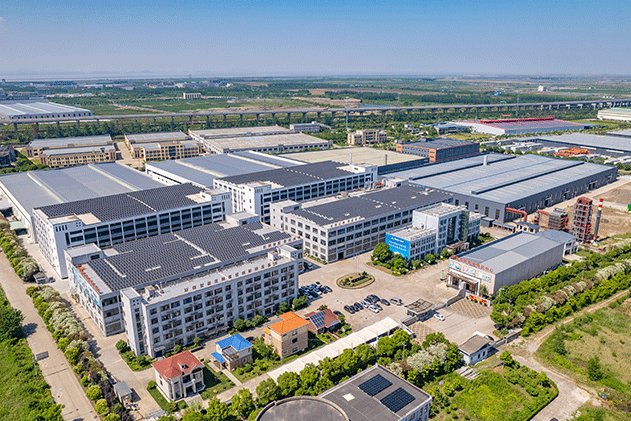
Oufei has been running co-extrusion lines since 1997 and operates more than 50 lines with a daily output above 200 tons, backed by ISO 9001 and SGS product certification. For buyers comparing multi-layer sheet suppliers, the useful question is not whether a cap exists. It is whether the mill can show bond integrity data, surface porosity control, and consistent tie layer formulation across production runs. That is where durability is actually built.
Copyright © 2026 by Hangzhou Oufei New Material Co.,Ltd. — Privacy Policy
 EN

 Hot News
 ONLINE